




How to Be Stylish on a Budget
The most common question I get is some version of: “How do I look good when I don't have a lot of money?”
The most important lesson to learn about style: money does not equal style. I've known women with overflowing closets who look like they got dressed in the dark, and women with a handful of well-chosen pieces who always look pulled together. Style is a skill, not a budget line item. But developing that skill does take some intention, especially when money is tight and every purchase has to count.
TL;DR
The Quick Version
Being stylish on a budget isn't about finding cheap dupes—it's about knowing your style, buying with intention, and taking care of what you own. These tips work no matter the size of your budget.
Real-Life Style: How to Look Stylish on a Budget
These are the tips I've come back to again and again, both from my years as a personal stylist, my decades writing about real-life style for women, and from living this myself.
Know Who You Are Before You Shop
The fastest way to waste money, regardless of your budget, is to buy things that don't reflect who you actually are. If you don't know your style, you'll keep reaching for things that seem appealing and feel wrong the moment they're in your closet.
Before buying anything new, spend some time assessing what you already own. What do you actually reach for? What sits unworn? What do you feel good in? I love the exercise of journaling your closet; writing down what you own, what you love, what you avoid and why. It sounds tedious, but it will tell you more about your style than any quiz or algorithm.
From there, build a simple vision of your style. Not aspirational-vacation-you or who-you-were-at-25… the current, actual, real-life right now you. What colors bring you joy? What silhouettes make you feel confident? What's your lifestyle actually calling for?
When you shop with that clarity, you stop making expensive mistakes.
Try Things On Before You Buy
Fit is everything, and fit is where budget clothing often falls short. A way to cut costs when making clothing is to stack more layers of fabric when cutting patterns. The higher the pile, the more chance for inconsistencies. This is why you can try two size 14 dresses from the same retailer and one is too big and one is too small.
- When shopping in person, ignore size labels and try things on. The number on the label does not determine a single thing. In fact, when you get home you can cut it out of your clothes!
- When shopping online don't go by the clothing number or letter, review size charts first. I also strongly suggest you read through customer reviews. It can feel time-consuming, but it can help you get closer to your closet goals.
When in doubt, buy slightly bigger. It's far easier to have something taken in than to squeeze into something that doesn't fit. And speaking of that…
Invest in a Tailor
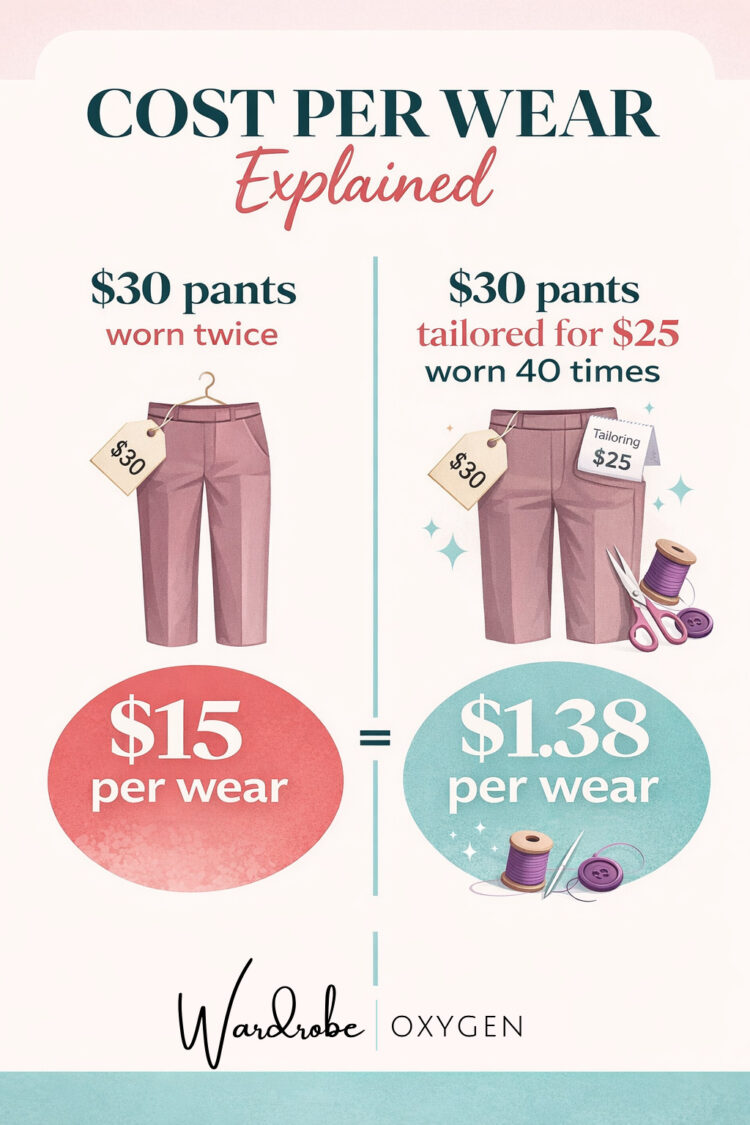
A good tailor is the single biggest upgrade you can make to a budget wardrobe. A $30 pair of pants that fits you perfectly will always look better than a $100 pair that doesn't. Your neighborhood dry cleaner can usually handle basic hems and simple alterations at a reasonable price. For more complex work—a blazer that needs taking in, trousers with a waist gap—look for a tailor or seamstress with solid reviews.
The math: spending $30 on alterations to $30 pants is still often a better investment than $60 pants that don't fit right.
ADVICE FROM A STYLIST:
Don't have a tailor in your neighborhood? Dry cleaners often offer alterations; at a minimum most can shorten a hem. Check local bridal and pageant dress salons; they usually work with a seamstress who may take on extra clients. Another option is check with a local theater group; someone on staff may make costumes and offer alterations on the side!
Keep a Simple Color Story
I swear by this style tip; once I lived it (and why I make so many capsule wardrobes), I realized how much simpler getting dressed can be and how much money can be saved: a simple, cohesive color palette is one of the most powerful things you can do for a limited budget.
When everything in your closet works together, you need fewer pieces. You don't need a different bag for every outfit or shoes in every color. You wear clothes more often because more combinations are possible. And here's the bonus: a solid, well-fitting piece in a classic color will almost always look more expensive than a busy print or an on-trend embellishment.
This is not being boring, this is not rewearing the same things. This is creating signature style. The most chic women in the world have a signature style. Think of Audrey Hepburn, Gwyneth Paltrow, Tilda Swinton, Tracee Ellis Ross… you could practically make a caricature of them based on their signature style. That's not boring, that's being iconic.
Pick a base color (black, navy, camel…whatever works for your life and complexion), one or two neutrals, and one or two signature colors you love. Build from there.
Be Thoughtful About Fabric
Not all budget fabric is created equal. Some holds up beautifully; some falls apart or looks cheap the moment you put it on.
What tends to work well at lower price points: matte jersey, ponte knit, merino wool, chambray, and viscose. What I'd be cautious about: 100% cotton in cheap construction (wrinkles badly, feels rough), and anything described as “cashmere” at a suspiciously low price (usually so thin and from such short fibers it pills immediately).
Feel the fabric before you buy. Hold it up to the light. Stretch it gently and see if it recovers. You can find quality at any price point if you know what to look for.
Skip the Fake Designer Pieces
This one isn't about ethics, it's about style. A knockoff designer bag, or a lower-end bag that's desperately trying to look like a designer version, reads as cheap no matter how much it cost. If you can't afford the real thing, buy something that stands on its own. A well-made bag in a quality fabric with no logos or obvious inspiration is always a better choice than a fake.
ADVICE FROM A STYLIST:
If you can't afford leather, then go with a fabric. Faux leather doesn't hold up, and it rarely looks like the real thing. However, there are some great places to get leather bags for less:
- Portland Leather has an almost-perfect department where you can get high-quality classic leather bags for less than $100. I've shopped here with great success.
- HOBO Bags has a program called HOBO Vintage where you can buy gently used leather bags for a fraction of the original price (I've gotten beautiful bags for under $50)
- From all the online resale sites, I have gotten the best deals on leather bags at ThreadUp. Takes a bit more searching, but items are often mislabeled or have no brand tag but are gorgeous quality for pennies on the dollar.
Where to Shop on a Budget
Thrift and consignment stores. The key is finding the right one. Thrift stores near wealthier neighborhoods tend to have better donations. Consignment shops and online resale platforms like ThredUp and Poshmark are excellent for finding specific brands at a fraction of retail.
- I highly recommend checking out Gem; it's a site and app that will save your online resale site searches and send you emails each time an item from your wish list is available.
Department store sale sections. This is underrated. Nordstrom, Neiman Marcus, and Bloomingdale's regularly have significant markdowns on their websites year-round… not just during big sales. I've found cashmere, leather shoes, and quality bags at prices that beat TJ Maxx. Search by your size, set a price filter, and check back periodically.
Clearance racks at quality stores. Ann Taylor, J.Crew, Talbots, and Banana Republic all have solid clearance sections. Go straight to the rack (they're usually in the back), buy only what's on your list, and leave. Don't browse. Clearance sections are designed to tempt you into buying things you didn't come for.
Big box retailers for the right categories. Some things are perfectly fine at lower price points: basics, jersey knits, casual layers. Lands' End in particular has solid quality for the price on everyday basics.
Shopping Is Not a Sport
If you don't need anything, don't go shopping. Not in stores, not online. Browsing creates want where none existed. Unsubscribe from retailer emails, unfollow social media accounts that make you feel like your wardrobe is constantly lacking, and make a habit of only shopping with a specific list and a specific need.
Don't shop when you're sad, stressed, or bored. Happiness has never been found on a hanger, and retail therapy is one of the more expensive forms of therapy with the worst long-term results.
Take Care of What You Have
Whether something cost $50 or $500, how you care for it determines how long it lasts and how good it looks. Hang things up after wearing. Spot treat instead of washing after every wear. Follow care instructions: many “dry clean only” items can be washed gently and hung to dry, but if in doubt follow the instructions. Polish and reheel your shoes. Steam out wrinkles rather than shoving things in a drawer. Mend fallen hems and replace missing buttons before they become a reason to toss something.
Caring for your clothes is free. It's one of the highest-ROI things you can do for a budget wardrobe.
Buy Less, Choose Better
You don't need a different outfit for every day of the month. I have to reiterate: Stylish women repeat outfits. It's not repeating, it's creating signature style. A well-fitting pair of black pants worn three times a week will always look better than seven mediocre pairs worn once each.
The smaller your closet, the easier it is to get dressed. Fewer decisions, more cohesion, more confidence. Buy thoughtfully, take care of what you own, and focus on fit over quantity.
FAQ
Want more on building a smarter wardrobe? Check out How to Create a Capsule Wardrobe and How to Look Polished.
Did you like what you just read?
Consider tapping here to buy me a coffee in thanks. The best gift you can give a content creator is the gift of sharing. Consider sharing this article on Facebook or Pinterest. Thank you so much for your support!